
Speaker: Roger P. Minert
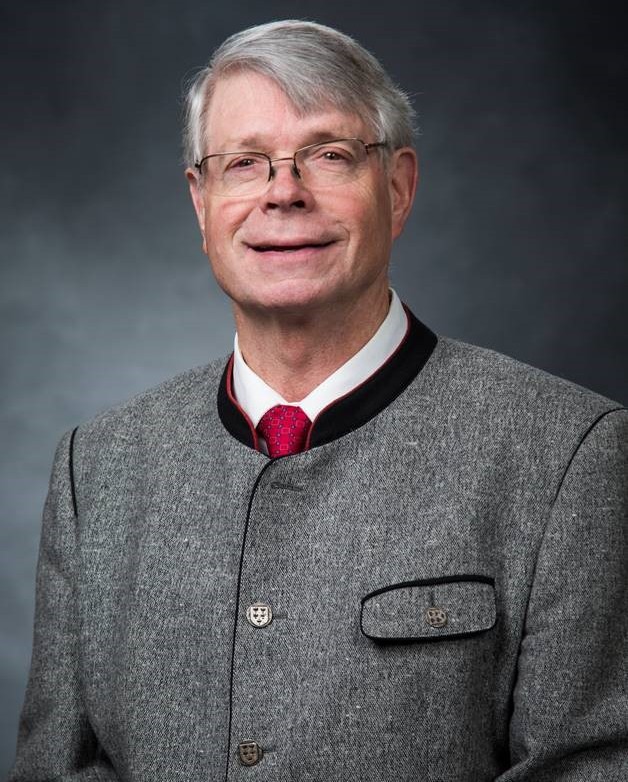
Areas of focus or expertise:
- Family research among Germans all over the world
- Deciphering old manuscripts
- German immigrants in the USA and their origins
Email contact: rogerpminert@gmail.com
Web/social media: www.rogerpminert.com
Home: Spring City, Utah
Native language: English
Presentation language(s): English and German
Preferred presentation type: virtual and in-person
Travel preferences: Anywhere, but the host covers travel expenses
Biography
Roger P. Minert received his doctoral degree from The Ohio State University in German language history and second language acquisition theory. He taught German language and history for 10 years, and then became a professional family history researcher.
Accredited by the Family History Library for research in Germany and Austria, he worked for 12 years as a private genealogical researcher. From 2003 to 2019, he served as a professor of family history at Brigham Young University. The author of more than 200 publications, he directs the research program German Immigrants in American Church Records [GIACR]; the series now consists of 42 volumes.
In 2019, Minert was recognized for his years of service to the Palatines to America Society and also received the “Shirley Riemer Lifetime Achievement Award” from the International German Genealogy Partnership. In 2020, he was named a fellow of the Utah Genealogical Association.
From his home in Provo, Utah he continues to write articles on Germanic genealogy, compile new GIACR volumes, and participate in conferences nation-wide.
In which societies are you a member? Pal-Am
Speaking experience/references
More than 300 professional presentations in USA, Germany, and Austria
Recording of previous presentation OR an IGGP partner you have presented for: Many have been recorded, but I don’t know how to access them.
Payment/expense arrangements
How do you approach payment for making a presentation? I am willing to negotiate a speaking fee with clients
Other expenses you would like to have reimbursed if you travel? Accommodation, meals, taxi, etc.
Recordings/additional materials
Are you willing to prepare a handout? Yes
Would you be willing to develop a presentation on another topic? Yes
Do you have any restrictions on recording, re-use of recordings, handouts, etc? Only with permission
Are you willing to have the presentation translated or translate it yourself? I translate it myself
Presentation topics
Rev. Jan 2023. Click title to expand.
What’s New in Family Research in Germany – 2022 edition
Duration 75 Minutes
This session consists of three main parts: A description of modern, i.e., post-2019, conditions for conducting family history research in Germany, including travel to and within Germany for that purpose. The second part is a discussion of the term Sütterlin and its role in the world of old German handwriting: does it apply to old church and civil records? This is a fascinating topic researched earlier this year by Prof. Minert in the Deutsche Nationalbibliothek. The third part of this session will consist of problems presented recently to Prof. Minert as “brick wall” or “dead end” situations; his answers to specific questions will be turned around to address the entire audience. The sky’s the limit!
Church Records in Germany
Level: All Duration: 60-90 minutes
This presentation is an introduction to the identification and location of church (vital) records for towns and cities in Germany (with borders as of 1871). The emphasis is on the types of records available in specific provinces during specific periods of time. The discussion features major historical events and developments associated with the keeping of vital records in Germany. Handouts include bibliographical data on church record inventories available in the LDS Family History Library. The 90-minute duration allows time for practice in reading typical church records.
Civil Records in Germany
Level: All Duration: 60-90 minutes
This presentation is an introduction to the identification and location of civil (vital records) for towns and cities in Germany (with borders as of 1871). The emphasis is on the types of records available in specific provinces during specific periods of time. The discussion features major historical events and developments associated with the civil registry system in Germany from the beginnings (1793) to the present. The impact of the 2009 laws and the current civil records repositories are discussed.
Introduction to German Phonetics as it Applies to the Spelling of Personal Names (or: “How can Tiefendörfer and Diependerper be the same family?”)
Level: All Duration: 90 minutes
Most researchers in German-language family history identify numerous variant spellings of personal names over time and in different locations. Despite the apparently helter-skelter variations, basic rules of Germanic phonetics are at work here. This presentation will offer linguistic explanations for specific spelling changes. With emphasis on problem-solving throughout, the presenter uses names supplied by the audience to illustrate the application of phonetic rules to the spelling of personal names in Germany and among German immigrants in North America.
Introduction to Linguistic Geography and its Relation to Family History Research in German Areas of Europe
Level: Very Advanced Duration 60-90 minutes
The history of the German language since the seventh century A.D. can be seen in surviving literary monuments. These documents allow linguists to trace patterns in consonant changes over many centuries–patterns that are closely connected to the geography of the German language territory. By studying those consonant patterns, the family history researcher can determine in which parts of Germany certain consonant changes occurred. This knowledge can be applied in determining the origin of a specific given name or surname. Knowledge of the German language would be helpful in this presentation, but is not required. The presenter can use names supplied by the audience to illustrate the relationship between consonant patterns and geography.
Conducting Family History Research in Europe
Level: All Duration: 90 minutes
Conducting family history research in an ancestral home town in Europe can be most satisfying, but also very challenging–even for the experienced professional. This presentation deals with the preparation and execution of a family history research excursion to Europe. The instructor uses a series of slides to describe various research locations and typical situations. The emphasis of this presentation is on avoiding and/or solving problems and increasing productivity in what can be a very expensive undertaking.
Cemeteries in Central Europe
Level: All Duration: 60-75 minutes
The customs associated with funerals and burials in German-language regions of Europe are substantially different from corresponding rituals in the United States. The layout and maintenance of cemeteries in also quite different. In this presentation, images are used to illustrate cemetery conditions and cultural customs associated with funerals and burials. The presenter demonstrates how the individual or family grave and its appearance are of great concern to Europeans. The question of death and burial records–often asked by North American researchers–is also discussed in detail. This presentation has been updated during Prof. Minert’s stay in Frankfurt am Main, Germany in 2021-2022.
Communicating With Agencies and Individuals in Europe
Level: All Duration: 45-60 minutes
Because not all vital records are available on microfilm in North America, many researchers find it necessary to communicate with churches, civil registrars, and private individuals in Europe. There are many challenges to such communication, and this presentation will guide novices and experts alike in overcoming such problems. Emphasis is placed on the locating of names and addresses, language considerations, payment of fees, etc. Attention is also given to telephone and telefax communications–an increasingly efficient way to obtain assistance in Europe.
Surname Changes in Northwestern Germany
Level: All Duration: 60-90 minutes
During the feudal era, hundreds of large estate farms were established in Western Hannover, Oldenburg, Westphalia, and Lippe-Detmold. On many of those estates, the surname of the owner did not change for over a thousand years, though blood lines quite often did. The conditions under which people lived on these estate farms and the patterns for surname changes and acquisition are discussed in this presentation. The focus is the effect such a widespread and complex system has on the tracing of family lines in this part of Germany.
Troubleshooting in Germanic Family History Research
Level: All Duration: Variable
The troubleshooting session is essentially an open forum, during which members of the audience are allowed to present–in great brevity–questions and problems specific to their own research scenarios. In suggesting solutions, the instructor expands the scope of each response to fit much broader circumstances, whereby numerous members of the audience benefit. Generally, the suggested solution of one problem leads coherently to the next problem etc. and the discussion can be terminated at any appropriate moment.
Avoiding “Self-Defeating Behaviors” in German Family History Research
Level: All Duration: 45-60 Minutes
Novices as well as experienced family history researchers tend to commit pattern errors (Aself-defeating behaviors@) and thus hinder or stymie their own progress. Such errors include over-estimating one=s capabilities, relying without question on research done by others, fear of or over-reliance on computer technology, and believing family legends that may well be inaccurate. This presentation features examples for each of the Aself-defeating behaviors@ in an attempt to assist the audience in recognizing and overcoming these problems. This presentation also lends itself well as a banquet or luncheon speech.
A day in the life of your German ancestor
Level: All Duration: 60-90 minutes
Most family history researchers are interested in the daily events in the lives of their ancestors. This presentation deals with the common activities of families on the farm and in the trades. The details provided represent the culmination of the presenter’s reading on the topic over the last two decades, from hard-to-find literature available only to the German audience.
A Genealogist’s Outline of German History since 1517
Level: All Duration: 60-120 minutes
This presentation examines the major events of German history from the time of Martin Luther to the early 20th century. The relationship between historical events and developments and the emigration of our ancestors from Germany is the focus of the presentation.
The Feudal Order
Level: All Duration: 60-90 minutes
Essentially everybody in the Germanic territories of Europe was affected to some degree by the feudal system that ended in the early 19th century. This presentation deals with the basis aspects of life under a feudal overlord and the effects of the feudal system in the daily lives of our Germanic ancestors.
Marriage and Courtship in Germany 1500 to 1800
Level: All Duration: 60-90 minutes
Perhaps the most important event in the life of our German ancestor was his marriage. Social and religious customs associated with courtship and marriage in German-language territories of Europe are discussed in detail in this presentation. Related issues such as illegitimate children, inheritance, and property acquisition at the time of the wedding are an integral part of this presentation.
Status in German Society 1500 to 1800: Where Did Your Ancestors Fit in?
Level: All Duration: 60-90 minutes
Thanks to a great extent to the very well-developed and rather inflexible feudal system in Germanic territories in Europe, our ancestors were quite stable in their social and economic status. The structure of classes (from the highest to the lowest) is described in this presentation, with an emphasis on correctly placing our ancestors on that social scale continuum. Advantages and disadvantages for our ancestors are discussed, as well as the advantages for modern historians searching for their ancestors in that world.
Surnames in German-language Regions of Europe
Level: All Duration: 60-90 minutes
One of the most fascinating topics among family history researchers in the German-language realm is that of names—especially surnames. This presentation features a description of the chronological and geographical introduction of surnames in Central Europe, the relationship between surnames and place names, and the tricky question of surname meanings and translations.
Professional Family History Research
Level: FH Professionals Duration: 60-90 minutes
Whether they work sporadically or daily for clients, professional family history researchers must deal efficiently with questions involving finances, advertising, promotion, marketing, interest, credit, escrow accounts, expenses, retainers, taxes and a host of other small details. This discussion is based on the presenter’s 32,000 hours of paid research experience, as well as information and observations collected from other professionals.
Research in Other German-language Regions of Europe
Level: All Duration: 60 minutes
This presentation will prepare researchers for the adventure of a lifetime: a visit to the hometown of the German ancestor. Important aspects of the planning include record repositories and procedures, local researchers, language challenges, lodging, travel, finances, meals, computer problems, and communications. The two presenters have made a total of 82 trips to Europe and are well aware of the latest conditions for traveling family historians.
Deciphering Handwriting in German Documents
Level: Beginning or Advanced Duration: 60-90 minutes
German-language church and civil records are only of value to those who can read the old German handwriting (commonly called “Gothic”). This presentation takes the novice reader from the initial process of identifying and recognizing the document to the point where a meaningful evaluation of the document’s content can be accomplished. Actual texts from many European sources are presented for analysis.
German Immigrants in American Protestant Church Records
Level: All Duration: 60-90 minutes
This presentation highlights the superb detail found in the records of German Protestant congregations in the United States (especially in the Midwest beginning in the 1830s). The contents of such records and their availability are demonstrated using the state of Indiana as an example. Interest in this topic is growing among German family history societies.
Form and Content in German Church Records
Level: All Duration: 60-90 minutes
This presentation includes a short history of the keeping of church records in the German-language countries in Europe, as well as in specific German provinces since 1490. Church and state regulations regarding the keeping of church records are discussed. A case study is demonstrated based on a typical parish in Württemberg with records from 1562 to 1876.
Gazetteers in Germany
Level: All Duration: 60 minutes
This new presentation (2013) is designed to help researchers understand the role and value of gazetteers and the methods used to locate and use this literature. How one moves from a gazetteer to a church record is demonstrated. Many examples are shown and websites are identified.
Census Records in Germany 1816-1916
Level: All Duration: 60-90 minutes
This new (2016) presentation is based on the results of my sabbatical stay of six months in Europe in 2015. The traditional mystery of German census records can now be explained: they are in many ways unlike their counterparts in the U.S. Frequency, content, methodology, and accessibility of these records in the thirty-eight states of the German Empire will be explained and illustrated.
Residential Registration in Germany
Level: All Duration: 60 minutes
This brand new (2017) presentation is based on a kind of record that is essentially unknown among Germanic researchers. From the sixteenth century on, local authorities monitored the comings and goings of strangers and foreigners, keeping ever more detailed records of newcomers—primarily for the safety of local residents. The personal details contained in such records make them a valuable resource for family history research. This presentation exhibits the form and content of residential registration and traces the historical development up to the late nineteenth century; by then, in most states every man, woman, and child was registered—whether local or from elsewhere.
Austrian Family History Research 2019
Duration 60-90 minutes
This presentation includes details collected during three years as a resident in Austria (nearly two of those years as an active family history researcher). The prime resources for genealogical research are presented and two of the finest genealogical websites anywhere are described and illustrated or demonstrated. Modern Austria is the focus, but the former crownlands (now parts of several modern countries) are also discussed.
The Making – and Keeping – of GIACR 2019
Duration 60 minutes
The book series German Immigrants in American Church Records was initiated in 2003. How it began is described and illustrated, as are its design, management, and administration. Access to the needed church records and interaction with churches, archives, and publishers are also treated.
German Immigrants in American Church Records: Lessons Learned in Sixteen Years 2019
Duration 60 minutes
Whereas most genealogists focus on vital records in cities, counties, and states, extensive study of Protestant church records reveals a much more valuable source for identifying the hometowns of German immigrants. This presentation illustrates insights gained over sixteen years of work in the program entitled German Immigrants in American Church Records. How to access and examine church records are important aspects of this study.
Civil Records vs. Church Records 2019
Duration 30 Minutes
Case studies in genealogy usually involve specific persons or families, but this one focuses on the types of records we need to gain data on our Germanic ancestors in the United States. The pursuit of one German family in northwest Ohio became a study of two men of the same name. The details found in records generated by governmental entities and those found in church records vary vastly. This presentation will give the audience new hope for re-starting what appear to be dead-end ancestral lines.